- Dozent/in: Julia Heesen
- Dozent/in: Marei Pelzer
Kursbereich: Soziale Arbeit Master – Studiengänge

Eine wissenschaftliche Schreibwerkstatt ist eine Lehr- und Lernmethode, bei der Studierende angeleitet werden, die Techniken des wissenschaftlichen Schreibens zu erlernen und anzuwenden.
Wissenschaftlich
zu arbeiten bedeutet immer auch zu schreiben: Im Studium sind es Qualifikationsarbeiten die zu Papier
gebracht werden wollen. Für Ihren
Schreibprozess, also die einzelnen Arbeitsschritte von der Idee zum
fertigen Text, brauchen Sie passende Schreib-Strategien. Diese werden hier vermittelt.

Eine wissenschaftliche Schreibwerkstatt ist eine Lehr- und Lernmethode, bei der Studierende angeleitet werden, die Techniken des wissenschaftlichen Schreibens zu erlernen und anzuwenden.
Mit Fokus auf bestimmte strukturelle Diskriminierungsdimensionen werden aktuelle gesellschaftliche Phänomene historisch hergeleitet, mehrperspektivisch/interdisziplinär kontextualisiert und die jeweiligen Kontinuitäten und Brüche erkannt und analysiert, um sie politisch aktuell einordnen und anbinden zu können.
Titel: Universalismus von Unten (Radikale Gleichheit) und Soziale Arbeit
Ausbildungsziel: Erworbene theoretischen Kenntnisse vertiefen und in einen Praxisbezug zu Kritischer Soziale Arbeit anwenden.
Inhalt: Validierung der theoretischen Annahmen aus dem ersten Master-Semester im Rahmen eines konkreten Forschungsprojektes.
Forschungsziel: Wir wollen herausfinden, ob und wie das Konzept der Universalität von unten - Radikale Gleichheit (im Sinne von Jule Govrin 2025) in der praktischen Sozialen Arbeit/ politischen Arbeit umzusetzen ist.In this course, specific social phenomena and problems are analysed and addressed in selected practice-oriented teaching research projects in the areas of social inequality, disadvantage and/or diversity. The projects may relate to the analysis of structural and/or epistemological discrimination, the individual effects of social inequality situations and/or different forms of difference categories in society, organisations or institutions.
The work on the practice-oriented academic projects aims to develop action-oriented concepts of social interventions that are derived from analysed needs of social communities, socio-spatial actors and social movements.
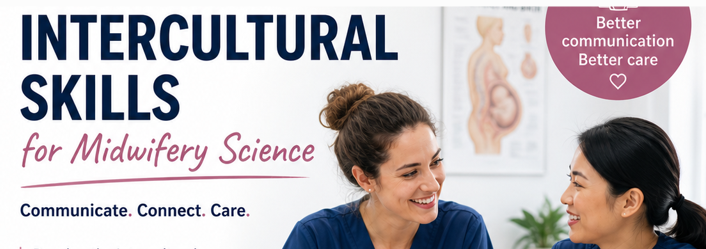
This short workshop addresses the challenges midwifery students face when engaging with English-language academic literature. It offers a supportive space to identify and reflect on linguistic uncertainties while developing strategies for reading and discussing research in English. Through guided activities, participants will begin building a collaborative glossary of key scientific terms. In addition, the workshop encourages awareness of intercultural aspects of communication in midwifery, helping students approach diverse perspectives in a more informed and reflective way.
Dear participants,
Welcome to the Academic Writing Workshop. The course begins today, and I’m looking forward to meeting all of you.
Location: Building / Room Mon, Tue, Wed - 2/321
Fri - 2/223
Schedule: 10:15 - 15:30
I will meet you in the classroom.
I wish you a great start and look forward to our first session!
Best regards,
Victor Hugo Malagón

Module Aim:
This module aims to equip students with essential skills for effective professional communication in English. By the end of the course, students will be able to navigate typical international communication scenarios in their field, interacting confidently with both specialists and non-specialists. They will also be prepared to follow English-medium lectures and coursework in their 3rd and 4th semesters with greater ease.
In addition to enhancing subject-specific language proficiency, the module supports the development of transferable key skills such as presentation techniques, academic and professional writing, and effective verbal communication. Emphasis is placed on mastering domain-relevant vocabulary and terminology.
Students will develop the ability to comprehend complex texts, including technical discussions in their area of specialization. They will be able to use appropriate language structures and vocabulary, with a focus on subject-specific lexical fields. Furthermore, they will learn to interpret a variety of text types suitable to their language level and academic context, such as technical documents, research reports, academic articles, and simplified specialist texts.
Materials:
The course uses a range of authentic materials, including recent publications from scientific and technical journals, blog posts, vlogs, business reports, and government newsletters.
5 ECTS, 5SWS i.e. 4SWS +1SWS (e-learning)
Coordinator: Ms. Lali Banerji
Contact information: lali.banerji@fra-uas-de
Office: Building 2 / Room 376
Consultation hours: by appointment